Overview
Provider Participation
Single Adults Scorecard: Questions 2A, 2B, 3A, 3B, 3C, 3D
Youth Scorecard: Questions 3A, 3B, 3C, 4A, 4B
Family Scorecard: Questions 3A, 3B, 3C, 4A, 4B
The foundational content below applies System-wide to all populations. Sections at the bottom of this page highlight areas where there may be population specific nuances for Single Adults, Youth, and Families.
Does our community’s by-name dataset include at least 90% of all individuals and households experiencing literal homelessness, and are all relevant providers contributing data to make that possible?
This page, along with related tools, resources, and case studies, will help you answer the provider participation questions across all three population scorecards. These questions cover two main themes:
- Whether at least 90% of providers — CoC-funded and non-CoC-funded — are reporting data into the by-name dataset
- Whether those providers collectively serve at least 90% of people experiencing homelessness, including people served through street outreach, emergency shelter, and transitional housing
How does BFZ define a “homeless response system” or “providers?”
BFZ defines a “homeless response system” as the organizations and entities serving individuals and households experiencing literal homelessness within a designated geographic area. A provider or homeless service provider refers to those organizations and entities that operate a program or offer services that primarily serve people experiencing homelessness. This can include nonprofit organizations, local and federal government agencies, faith-based organizations, the U.S. Department of Veterans Affairs, and other homeless coalitions.
The provider participation scorecard questions organize providers into the following categories, which may not capture every provider type in your community:
- Providers that serve people experiencing unsheltered homelessness, including street outreach services, hotlines, day shelters, and other access points
- Emergency shelters, safe havens, seasonal overflow beds, hotels paid for by homeless providers, Health Care for Homeless Veterans (HCHV) beds, domestic violence shelters, and Basic Center Program (BCP) shelters for youth
- Transitional housing, including VA-funded Transitional Housing, Runaway Homeless Youth (RHY) Transitional Living Programs (TLP), and Independent Living Programs (ILP) for youth transitioning from foster care
- Permanent Housing programs including Rapid Rehousing (RRH), Permanent Supportive Housing (PSH), and Other Permanent Housing (OPH), as well as youth projects funded through the Youth Homelessness Demonstration Program (YHDP) and Foster Youth to Independence (FYI) vouchers
Depending on how coordinated entry is structured in your community, the organization that runs coordinated entry may also be included on your provider list.
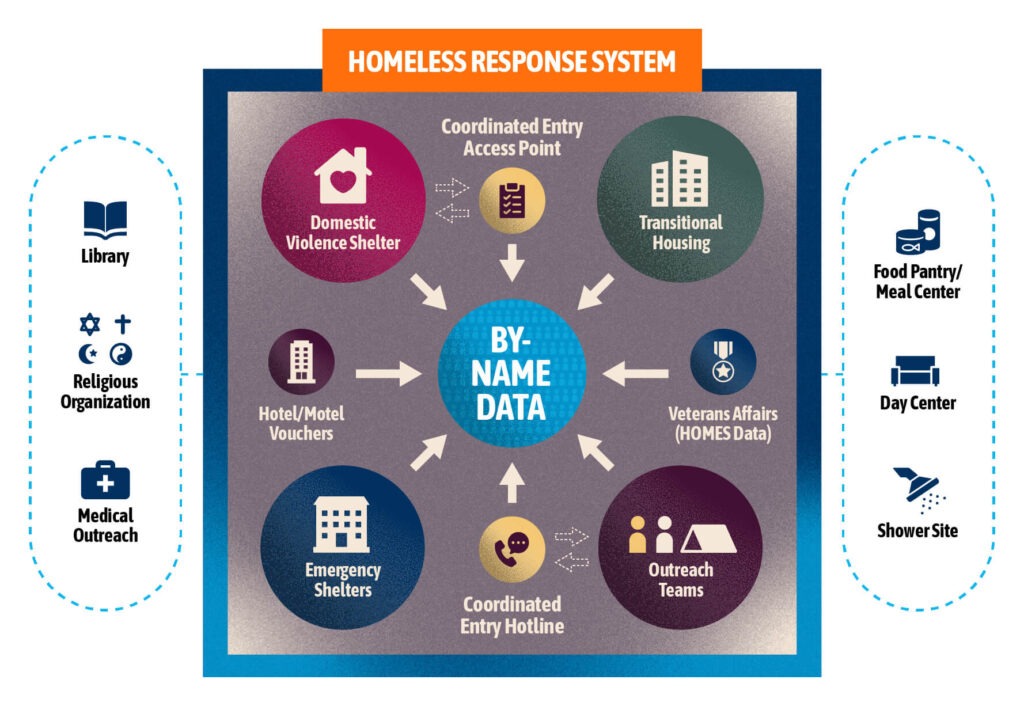
Depending on how coordinated entry is set up in your community, the organization that runs coordinated entry may also be included on your provider list.
What about organizations that don’t fit the definition of a homeless service provider?
Some communities may need to include organizations outside the traditional homeless response system to reach the 90% threshold, such as hospitals, food banks, general assistance programs, or justice-involved systems. It can also include organizations that refer people to services but don’t provide direct services themselves, such as libraries, general services hotlines, and others.
As with much of this work, context matters. Communities are encouraged to apply these concepts in ways that make sense locally while keeping the core goal in focus: ensuring that at least 90% of people experiencing homelessness are reflected in the by-name dataset in any given month.
Why does provider participation matter?
Builds a shared understanding of the system
Analyzing and documenting the provider landscape helps partners and stakeholders get clearer about who makes up their homeless response system. This process can surface gaps that weren’t previously visible and gives community teams the information they need to better coordinate, communicate, and improve their data.
Improves equitable access to resources
When more providers contribute data, communities can reduce the likelihood that someone falls through the cracks simply because of where they present as experiencing homelessness. A complete provider landscape analysis allows communities to identify gaps and work toward ensuring that all locations where people may seek support are connected to the by-name dataset so people and households can be quickly identified and linked to the services that best fit their needs.
As communities work on answering yes to 3A and 3D, the question of how to collect anonymous or limited data often comes up as a consideration. For more on this topic see the Tracking Unassessed section.
How to assess provider participation and contribution across your system?
Assessing provider participation starts with building a shared understanding of your community’s provider landscape and determining which providers are contributing data to the by-name dataset.
The scorecard questions ask communities to evaluate two related but distinct things:
- Are at least 90% of providers reporting data into the by-name dataset?
- Do those providers collectively serve at least 90% of people experiencing homelessness?
The distinction matters. For example, if 95% of providers are contributing data, but the 5% that don’t serve 15% of the population, you may answer “yes” to the first question but “no” to the second. Similarly, a provider may technically be contributing data while only capturing a fraction of the people they serve. For instance, if only half of a shelter’s clients are entered into HMIS, a significant portion of that shelter’s population may be missing from the dataset.
The scorecard questions also ask communities to look at participation across specific provider types, including street outreach, emergency shelter, and transitional housing, since each type may approach data collection differently. Gaps in any one area can meaningfully affect the comprehensiveness of the dataset.
The BFZ Provider Participation Inventory Tool can help your community document your provider landscape and evaluate where gaps exist.
For communities working on questions related to collecting limited or anonymous data, the Tracking Unassessed section includes relevant resources and guidance.
Population-Specific Guidance
The content above applies to provider participation System-wide across all populations. The sections below highlight key nuances and considerations for specific populations your community may be focusing on. (On the toolkit website, these sections will appear as collapsible accordions.)
Provider participation work for Single Adults requires collaboration across traditional and non-traditional partners.
Key considerations for single adult provider participation:
- Collaboration with Veteran Administration: VA providers, including VA-funded programs and HCHV beds, are an important and sometimes overlooked part of the Single Adult provider landscape. Communities should ensure VA programs are included in provider participation assessments and that clear data-sharing processes are in place.
The youth homeless response system often operates more independently from the broader homeless response system, with its own network of providers, funding streams, and coordinating bodies. This can create gaps in provider participation if youth-specific providers are not intentionally included in the community’s overall provider participation inventory (link to tool page).
Key considerations for youth provider participation:
- Drop-in Centers: Drop-in centers and youth-serving organizations may serve young people experiencing homelessness without identifying them as such. Including these providers in the landscape assessment can surface a significant portion of youth who may otherwise be missing from the dataset.
- RHY Programs: Runaway and homeless youth (RHY) programs – including basic center programs, transitional living programs, and street outreach funded through the Family and Youth Services Bureau (FYSB) – may not be formally integrated into CoC-funded coordinated entry systems. Communities should assess whether these providers are contributing data to the by-name dataset and establish pathways if they are not.
- Adjacent Systems: School systems (McKinney Vento Liaisons), Juvenile Justice Partners, and Child Welfare and Foster Care providers including Independent Living Programs (ILPs) or transition services for aging out youth are often the first point of contact for unstably housed youth. More information about collaborating with these providers can be found on the [Adjacent Systems] section of this toolkit.
- Culturally specific and “By-and-For” Organizations: Black, Indigenous, and People of Color (BIPOC) and Lesbian, Gay, Bisexual, Transgender, and Queer/Questioning (LGBTQ+) youth are disproportionately impacted by homelessness and frequently avoid mainstream systems due to past trauma or systemic discrimination. Therefore, it is essential to engage by-and-for organizations intentionally led by and created for these specific communities. Because these agencies and grassroot groups possess deep, built-in trust and affirming spaces, they are often the first and only access points for marginalized young people. Your inventory should actively seek out BIPOC-led advocacy groups, Tribal youth programs, and LGBTQ+ community centers, even if they do not explicitly identify as traditional homeless service providers.
- Unaccompanied Minors: While most communities have policies, procedures, and services in place for young adults, many communities may need to expand their system to ensure unaccompanied minors are included. This means determining how the community will broaden its reach to capture all literally homeless unaccompanied minors, documenting how data will be collected and by whom, and intentionally building out youth-centric services for this particular population.
Coming Soon
Built for Zero is actively gathering best practices in family systems. Additional guidance will be added to this section as communities share their approaches.
Submit Questions or Feedback
We want to hear from you! Let us know if you have specific feedback, comments, or questions about the material on this page.
Submit Questions or Feedback
We want to hear from you! Let us know if you have specific feedback, comments, or questions about the material on this page.