Overview
By-Name Data Management
Single Adults Scorecard: Questions 6, 8
Youth Scorecard: Questions 8, 10
Family Scorecard: Questions 7, 9
The foundational content below applies System-wide to all populations. Sections at the bottom of this page highlight areas where there may be population specific nuances for Single Adults, Youth, and Families.
Does our community have established protocols to manage our by-name dataset and ensure data is timely, accurate, and complete?
This page, along with related tools, resources, and case studies will help you answer the by-name data management questions across all three population scorecards and to better understand by-name data management practices.
What is by-name data management?
By-name data management includes the practices, protocols, and policies a community adopts to ensure that the data they’re producing accurately reflects the reality of people and households experiencing homelessness in their region. Fundamental principles include developing and socializing written protocols that identify roles and responsibilities to ensure data is accurate, timely, and complete.
By-name data management is more than collecting numbers, it’s about ensuring those numbers help communities understand and respond to the challenges people and families face, and ultimately design systems that are more effective and compassionate.
Why does by-name data management matter?
Builds trust and transparency
Documenting data processes and protocols helps providers, decision-makers, funders, and the public have confidence in the integrity of the data, ensuring resources are allocated effectively and outcomes are accurately understood.
Improves services and outcomes
Strong data practices help communities track outcomes, identify trends, and ensure services reach those who need them. When services are informed by well-managed data rather than assumptions, people experiencing homelessness are more likely to trust the system and be connected to the right resources.
Enables continuous improvement
A well-managed dataset helps communities identify areas for improvement and highlight successes. Continuous monitoring allows for real-time adjustments to better meet the needs of those being served.
How does by-name data management differ from HMIS data quality?
By-name data management can look similar to and, in some cases, overlap with Homeless Management Information System (HMIS) data quality, but includes practices specific to tracking list and population statuses that are not necessarily included in HMIS data quality practices. Additionally, by-name data can include information outside of HMIS that is not governed by HMIS data quality protocols.
Examples of by-name data management practices
Make data management a community-wide effort
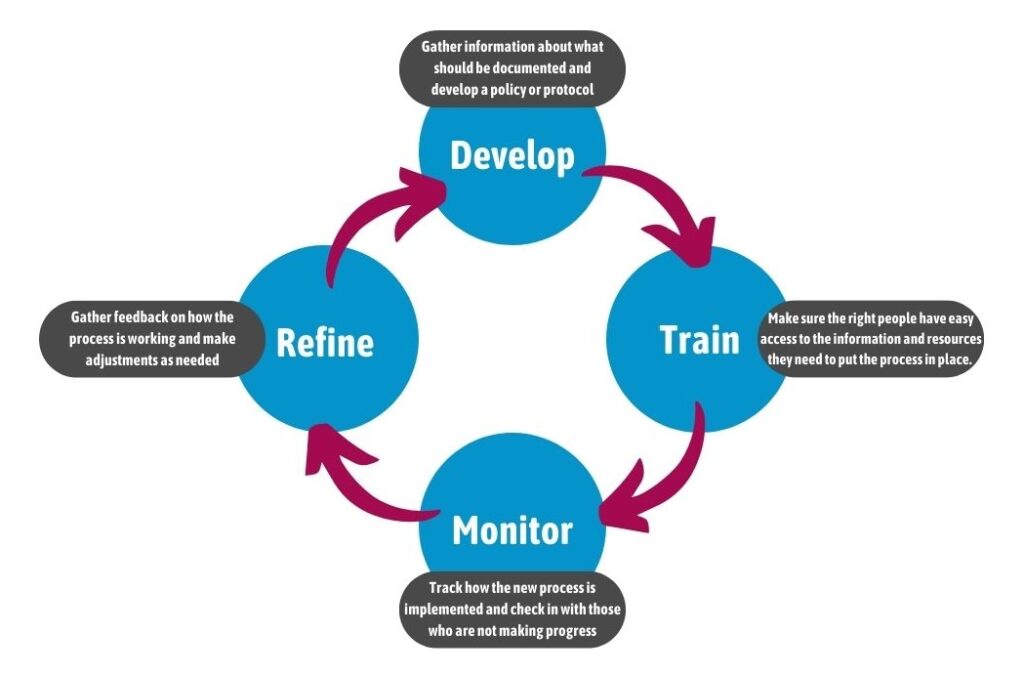
Effective data management depends on an ongoing feedback loop involving service providers, front-line staff, people with lived expertise, leadership, and governing boards. These stakeholders should be involved in designing data systems, setting expectations, and regularly reviewing and refining practices. In the ever-changing landscape of homeless services, data management practices will shift over time, which is why the process of developing, training, monitoring, and refining must be continuous.
Clarify roles and responsibilities
Complex systems are hard to manage without clear ownership. Communities should ensure that expectations around data entry, quality assurance, and reporting are clearly communicated to all providers, and that training is provided to support consistent implementation.
The BFZ By-Name Data Management Manual can help your community develop and document data management practices that apply across all populations.
Examples of by-name data management practices:
- Defining by-name data for your community. With many people entering and interacting with community data, it is important to establish a shared understanding of what the by-name dataset is and what data it includes across your focus populations.
- Managing duplicate profiles. Each person in the by-name dataset should have a unique identifier (such as an HMIS ID) assigned only to them. Regularly auditing for and merging duplicate profiles ensures the dataset accurately represents unique individuals and families.
- Closing outdated enrollments. Program enrollments left open after someone is no longer receiving services can misrepresent who is actively experiencing homelessness and inflate active system counts. Regular oversight is needed to ensure these enrollments are closed in a timely manner.
- Monitoring consistent data entry. If data entry to record interactions with a client is not happening, that person or household may fall off the active list even if they are still experiencing homelessness. Regularly monitoring the active list ensures data entry is up to date and reflects reality.
- Monitoring inactive records. Records should be monitored in accordance with the community’s inactive policy to ensure that individuals and households who are no longer active are appropriately removed from the active list. For more information, see the [Inactivity] section.
Documenting by-name data management practices can look different for every community. See the tools and resources section for ideas and more information.
Population-Specific Guidance
The content above applies to by-name data management System-wide across all populations. The sections below highlight key nuances and considerations for specific populations your community may be focusing on. (On the toolkit website, these sections will appear as collapsible accordions.)
The System-wide data management guidance above applies to the Single Adult population, and communities will find that most standard data management practices translate well to this specific group. The BFZ By-Name Data Management Manual covers the full range of data management considerations and can be used as a starting point for developing or refining your community’s practices.
Key considerations for single adult data management:
- Ensuring Households are Set Up Correctly. Single adults may be in a household on their own or in a household with other adults. Regardless, every household in the by-name dataset should have a designated Head of Household (HoH). Communities should regularly audit their dataset to flag households with no identified HoH and resolve those records promptly.
Data management for youth introduces important considerations around confidentiality, data access, and household composition changes that communities should address explicitly in their data management protocols.
Key considerations for youth data management:
Dynamic Household Structures: Because youth may experience frequent couch-surfing, form temporary chosen families, reunite with their parent or guardian, or transition into parenting youth, their household compositions change rapidly. Data quality protocols should include processes to ensure these fluid household structures are accurately updated in the dataset so young people are prioritized for the correct housing resources.
Minor Confidentiality and Data Access: Records for young people — particularly unaccompanied minors and youth fleeing trafficking and domestic violence — require elevated confidentiality protections that limit who can view or interact with their data. Communities should ensure that their data management protocols explicitly address how minor records are handled in HMIS, including who has access and under what circumstances information can be shared.
Managing the “Aging Out” Transition: Data management practices should include a rigorous, documented workflow for when a young person ages out of the youth system (e.g. turning 25). Protocols should ensure their record, active status, and historical data are seamlessly transferred to the Single Adult or Families Dataset without disruption in services.
Coming Soon
Built for Zero is actively gathering best practices in family systems. Additional guidance will be added to this section as communities share their approaches.
Submit Questions or Feedback
We want to hear from you! Let us know if you have specific feedback, comments, or questions about the material on this page.
Submit Questions or Feedback
We want to hear from you! Let us know if you have specific feedback, comments, or questions about the material on this page.