Overview
Tracking Population & Subpopulation Statuses
Single Adults Scorecard: Questions 11C, 12A, 12B, 12D, 12E
Youth Scorecard: Questions 13c, 14a, 14c, 14d
Family Scorecard: Questions 12c, 13a, 13c, 13d
The foundational content below applies System-wide to all populations. Sections at the bottom of this page highlight areas where there may be population specific nuances for Single Adults, Youth, and Families.
Does our community’s by-name dataset accurately reflect the population and subpopulation status of every person and household experiencing homelessness and track changes in these statuses, including household type, veteran status, and chronic homeless status?
This page, along with related tools, resources, and case studies, will help you answer the population and subpopulation status questions across all three population scorecards and to better understand the population and subpopulation status of people experiencing homelessness in your community.
What are population and subpopulation statuses?
Population and subpopulation statuses are categorizations used in the by-name dataset to identify individual and household characteristics that help us understand the unique needs of people experiencing homelessness. Identifying and tracking population and subpopulation statuses for each person allows communities to tailor system-wide interventions more effectively and match people with the right resources based on their specific circumstances. Key terms are listed below and are explained in more detail in the Built for Zero Reporting Reference Guide.
Population status: Sometimes referred to as household type, this status includes Single Adults, Youth, and Families
Subpopulation status: This status indicates tracked or unique characteristics and includes individuals who are veterans and/or chronically homeless
No Longer Meets Population Criteria: This status is used to identify when a person’s population or subpopulation status changed over the course of the month and often indicates a change to their unique characteristics or housing situation. This status is part of a community’s monthly outflow, which is explained in more detail on the [tracking list statuses] page. Real world examples of when a person no longer meets population criteria are included below.
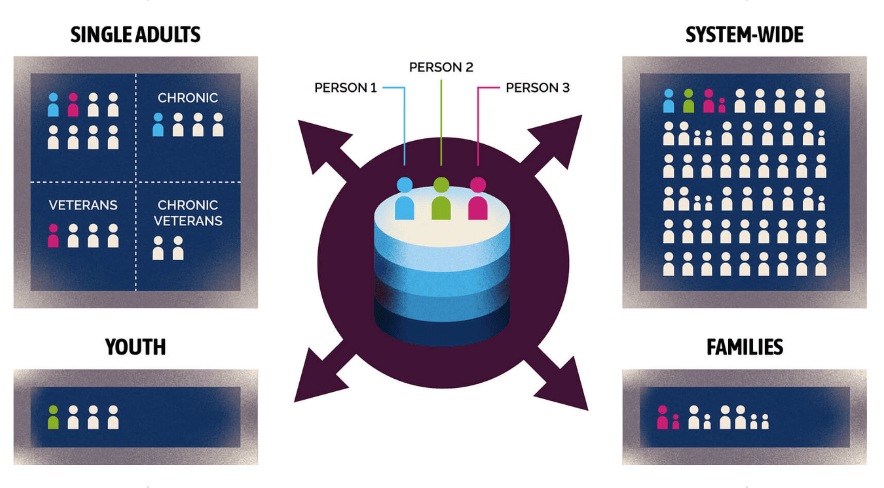
Person 1: Represents a 65 year old individual who is experiencing chronic homelessness. This person would be included in the Single Adult, Chronic, and System-wide reporting categories.
Person 2: Represents a 23 year old individual. This person would be included in the Youth and System-wide reporting categories.
Person 3: Represents a 26 year old veteran with an 8 year old child. The adult would be included in the Single Adult, Veteran, Family, and System-wide reporting categories. The child would be included in the Family and System-wide reporting category.
Why does tracking population and subpopulation status matter?
Tracking population and subpopulation status recognizes that each person and household within the homeless response system has a distinct journey and set of needs. Understanding these unique characteristics enables us to meet people where they are, providing the most effective support on their path to housing stabilization. Many housing resources have specific eligibility criteria related to factors such as chronic homelessness, veteran status, and household composition. Therefore, it is crucial to ensure that communities are able to track these particular population characteristics and facilitate access to appropriate resources.
Some examples of why tracking population and subpopulation status matters are outlined below.
It helps communities match people with the right resources.
When communities can’t accurately track population and subpopulation statuses, they risk matching people to resources that don’t align with their needs, driving up unsuccessful housing referrals. Accurate population and subpopulation tracking allows communities to diagnose this kind of mismatch and monitor whether corrective action improves referral outcomes.
It helps communities develop a nuanced understanding of who is experiencing homelessness and ensure that services are aligned with the diverse needs of those within the region.
Subpopulation tracking, such as chronic homeless status, can surface gaps in staff capacity or service design that are contributing to long lengths of time homeless. This allows communities to target interventions, like adding case management or peer support capacity, and monitor whether those interventions reduce the number of people approaching or remaining in chronic homelessness.
It helps communities ensure the correct providers are at the table to support the unique needs of their community.
Tracking population and subpopulation status can reveal when a community lacks a needed partnership, such as with Veteran, Family, or Youth providers that’s causing delays in connecting people to resources they’re eligible for. Identifying this gap through the data allows communities to prioritize the right partnerships and monitor whether those partnerships improve housing placement rates and reduce time spent homeless.
It helps communities accurately capture and serve families and youth across the full scope of their needs.
Population status tracking that doesn’t account for intersecting categories, such as parenting Youth who also meet the definition of the Family population, can result in households being excluded from case conferencing and resources they’re eligible for. Establishing clear local protocols for these intersectionalities ensures households aren’t overlooked and prevents the same gap from recurring.
What is household type and how is it tracked?
Household type, sometimes referred to as population status, refers to the make-up of individuals in a household, regardless of their relation to one another. Key terms related to tracking household type are listed below.
Single Adults: Includes households with at least one member 25 years or older and all other members 18 years or older
Youth: Includes households in which all members are age 24 and younger
Families: Includes households with multiple members and at least one member under the age of 18
*While it is important to understand the household type of everyone in the homeless response system, this resource will specifically focus on single adults.
Household type can be tracked using HMIS Universal Data Element 3.03 – Date of Birth, 3.15 – Relationship to Head of Household, and 2.07 field 4 – Household Type.
A note on pregnant or parenting youth and young adults: Individuals aged 24 or younger who are pregnant or parenting minor children sit at the intersection of the Youth and Family populations. Communities should reach a local consensus on whether this group is counted within the Youth population, the Family population, or both, and document that decision consistently. See the population-specific sections below and the Built for Zero Reporting Reference Guide for more guidance.
See population specific information below for more guidance on tracking Single Adult, Youth, and Family household types.
What is veteran status and how is it tracked?
Built for Zero recognizes HUD’s definition of veteran and is inclusive of anyone who has ever been on active duty in the armed forces of the United States, regardless of discharge status or length of service.
Veteran status can be tracked using Universal Data Element 3.07 in HMIS. While this is a self-reported field, communities are encouraged to do some verification of this status to ensure the accuracy of their by-name dataset and to support appropriate resource matching. To do this, it is vital that VA partners are at the table.
Some communities may not have the capacity to verify veteran status. In this case, BFZ recommends including anyone who self-identifies while working through a verification process that ensures all veterans are served equitably.
Veteran status verification can be broken down into three main categories:
- Self-report with no record
- Veteran ineligible for VA services
- VA eligible
Veteran status cuts across all household types, and all veterans should be included in the BFZ Veteran reporting group AND the Single Adults reporting group, regardless of their age or household type. Some examples are outlined below.
- A 22-year-old who is a veteran in a household by themselves should be included in the Youth, Single Adults, and System-wide population as well as the Veteran subpopulation.
- A 40-year-old veteran in a household with their 40-year-old non-veteran partner and minor children should be included in the Single Adults, Family, System-wide and Veteran subpopulation. All non-veteran household members should be included in the Family and System-wide population.
- A 30-year-old veteran and their 25-year-old veteran sibling in a household with their 16-year-old sibling should be included in the Single Adults, Family, and System-wide population as well as the Veteran Subpopulation while the 16-year-old sibling should only be included in the Family and System-wide population.
What is chronic status and how is it tracked?
Built for Zero recognizes HUD’s definition of chronic homelessness and is inclusive of any person with a disability who has been homeless for 12 consecutive months or experienced four episodes of homelessness totaling 12 or more months over the past three years.
Chronic homeless status can be tracked using Universal Data Elements 3.917 – Prior Living Situation and 3.08 – Disabling Condition in HMIS, along with length of time data for current project enrollments. While these are self-reported fields, communities are encouraged to do some verification of this status to ensure the accuracy of their by-name dataset and to support appropriate resource matching.
When and how a community verifies chronic homeless status depends on many local factors. It is recommended that anyone who is presumed to be chronically homeless be included in this reporting group.
Chronic homeless status verification can be broken down into three main categories:
- Unable to verify length-of-time (LOT) homeless
- Unable to verify qualifying disability
- Chronic homeless status verified
People who are chronically homeless are some of our most vulnerable neighbors. The longer they stay without a home, the more trauma they experience and the more barriers to housing they’re likely to face. Identifying those people in the community who were not chronic at entry and become chronic later and those who are at risk of chronicity is a key part of maintaining a quality by-name dataset, and it is a critical part of supporting this vulnerable group of people. It’s also helpful for communities to know how many people are close to becoming chronically homeless so they can better understand and support this group.
What is no longer meets population criteria and how is it tracked?
No longer meets population criteria (NLMPC) denotes that a person’s unique population characteristics have changed. This chanNo longer meets population criteria (NLMPC) denotes that a person’s unique population characteristics and/or household type have changed. This change in population or subpopulation often indicates a need for different services and resources. We track NLMPC because it helps to understand how a person or household’s status can change over time in a dynamic system. It also supports informed decision-making to identify the resources most needed in a given area. Some examples of NLMPC are outlined below.
- A household consisting of two 25-year-olds welcomes their first baby. This change would result in the two 25-year-olds exiting the Single Adults reporting group due to no longer meeting population criteria and entering the Family reporting group as newly identified.
- A 24-year-old turns 25. This change would result in the individual exiting the Youth reporting group due to no longer meeting population criteria and entering the Single Adults reporting group as newly identified.
- All minor children in a family household turn 18. The household would exit the Family population as no longer meets population criteria and enter to the Single Adults population as newly identified, as the household no longer includes any minors.
- It’s discovered that a 30-year-old who self-identified as a veteran never served a day of active duty. This realization would result in the individual exiting the Veteran reporting group due to no longer meeting population criteria and remaining active in the Single Adults reporting group.
Tracking no longer meets population criteria as part of outflow can help to understand changes in a population or subpopulations over time. Read more about tracking outflow here.
Population-Specific Guidance
The content above applies to tracking population and subpopulation status System-wide across all populations. The sections below highlight key nuances and considerations for specific populations your community may be focusing on. (On the toolkit website, these sections will appear as collapsible accordions.)
The Single Adults population includes:
- Single adults (i.e. no other people in the household) 25 or older
- Adult-only households (all household members are ≥ 25 years old)
- Households with at least one adult ≥ 25 years old, and all remaining household members are ≥ 18 years old
- All veterans, regardless of age or household type, are also included in the single adult population
Chronic and Veteran are subpopulations of the Single Adult population. Quality Data for these subpopulations must be achieved prior to or at the same time as Single Adult Quality Data.
Key considerations for tracking Single Adult population status:
- Newly Identified to Single Adult population:
- When a young person turns 25, they will inflow to the Single Adult population as newly identified while simultaneously outflowing from the Youth population as no longer meets population criteria.
- When a Family household’s youngest member turns 18, they will inflow to the Single Adult population as newly identified while simultaneously outflowing from the Family population as no longer meets population criteria
- When all minors leave a household, the adults will inflow to the Single Adults population as newly identified while simultaneously outflowing from the Family population as no longer meets population criteria
- No Longer Meets Population Criteria for Single Adult:
- When a minor under the age of 18 joins an adult only household, this constitutes a change to population status. The adults should outflow from the Single Adults population and the household that now includes a minor will inflow as newly identified to the Family population.
The Youth & Young Adults population includes:
- Youth: Unaccompanied minors under the age of 18 (i.e. who are not part of a household with at least one member over the age of 24).
- Young Adults: Unaccompanied transitional aged youth 18-24 (i.e. who are not part of a household with at least one member over the age of 24 and not part of an adult-only household).
- Pregnant or Parenting Youth & Young Adults: Individuals aged 24 or younger who are pregnant or parenting minors.
Tracking youth and young adult populations requires a tailored approach due to their unique demographic profiles, changes in family composition, and housing patterns.
Key considerations for tracking youth population & subpopulation statuses:
- “Aging Out” or Change in Household Type Transitions: A young person will be moved to Outflow: No Longer Meets Population Criteria when they age out of the youth system (e.g., turning 25) or when they experience a change in household type, such as joining a family unit and are no longer unaccompanied. Communities should establish a documented “warm handoff” protocol when a young adult ages out of youth population criteria, ensuring a seamless transition to the Single Adult or Families dataset, preventing the young person from falling through the cracks.
- Parenting Youth: Create clear local guidelines for tracking households for which the head of household is a youth (24 or younger with dependents), determining whether they should be accounted for on the Youth and Young Adult dataset, Families dataset, or both.
- Evaluating Chronic Status: Consider your community’s data entry practices and how it might impact assessing chronic homelessness, as frequent couch-surfing or doubled-up creates breaks in “literal homelessness” that complicate length of time calculations.
Coming Soon
Built for Zero is actively gathering best practices in family systems. Additional guidance will be added to this section as communities share their approaches.
Submit Questions or Feedback
We want to hear from you! Let us know if you have specific feedback, comments, or questions about the material on this page.
Submit Questions or Feedback
We want to hear from you! Let us know if you have specific feedback, comments, or questions about the material on this page.