Overview
Tracking List Statuses
Single Adults Scorecard: Questions 7, 9, 10, 11A, 11B, 12C
Youth Scorecard: Questions 9, 11, 12, 13a, 13b, 14b
Family Scorecard: Questions 8, 10, 11, 12a, 12b, 13b
The foundational content below applies System-wide to all populations. Sections at the bottom of this page highlight areas where there may be population specific nuances for Single Adults, Youth, and Families.
Does our community’s by-name dataset accurately reflect who is experiencing homelessness in our system and show how individuals have entered or exited our system over the past month and historically?
This page, along with related tools, resources, and case studies, will help you answer the tracking list statuses questions across all three population scorecards. The concepts covered will help your community understand how to track the list statuses of people experiencing homelessness and why it matters for system improvement efforts.
What is a list status?
By-name data list statuses are part of the Built for Zero methodology for identifying how someone is showing up in the homeless response system. List statuses differ from population and subpopulation statuses, which are described in further detail in the [Tracking Population-Based Statuses] section. Identifying and tracking the list status of each individual helps communities maintain a complete and accurate view of who is experiencing homelessness and how they are entering and exiting the system. Key terms are defined below and can be found in more detail in the Built for Zero Reporting Reference Guide.
Active: People who are experiencing literal homelessness in your system as of the last day of the month.
Inflow: Statuses that identify a person who entered the homeless response system during a specific month or who was newly identified as part of a population or subpopulation during the month. Includes newly identified, returned from housing, and returned from inactive.
- Newly Identified: Any person who first began experiencing homelessness in your community during the month, or who met the criteria for a new population during the month (i.e., become chronically homeless after entering homelessness as not chronic).
- Returned to Active from Housed: Any person who first began experiencing homelessness during the month and who was previously housed within your community’s geographic region.
- Returned to Active from Inactive: Any person who first began experiencing homelessness during the month and who was previously experiencing homelessness within your community’s geographic region but had become inactive.
Outflow: Statuses that identify a person as no longer active within your community’s geographic region, or as no longer part of a population or subpopulation during a specific month. Includes housed, inactive, or no longer meeting the population criteria of a specific population or subpopulation.
- Housed: Any person who was experiencing homelessness and was permanently housed during the reporting month, including those housed through the homeless response system and those who self-resolved their housing crisis. We recommend that communities identify which of the HMIS exit destinations (Universal Data Element 3.12 – Destination) indicates a permanent housing destination locally.
- Inactive: Any person who was experiencing homelessness but as of the last day of the month is no longer known to be experiencing homelessness in the area, per the community’s inactive policy. Read more about [inactivity here].
- No Longer Meets Population Criteria: Used to identify when a person’s population or subpopulation status changed over the course of the month, often indicating a change to their unique characteristics or housing situation. Read more about [tracking population-based statuses here].
A note on lookback periods: Communities often establish a lookback period to determine whether someone is “newly identified” or a “return” to active homelessness meaning only those with a previous episode of homelessness that ended within the lookback period would be considered a return. While two years is a commonly used lookback period to align with the 24-month HUD System Performance Measure, this is not prescriptive. Communities may adopt a timeframe that is most appropriate for their specific system, including a substantially longer period. Lookback periods should be applied equally across all populations.
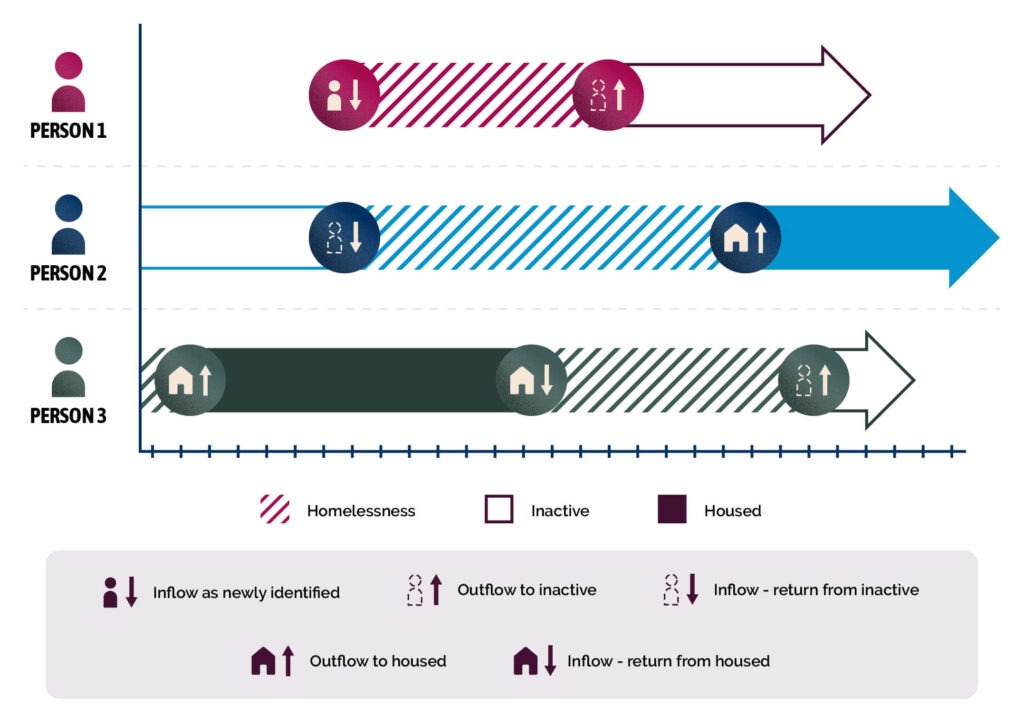
*Communities often establish a “lookback period” to determine the timeframe to consider if someone is “Newly identified” or a “Return” to active homelessness, meaning that only those with a previous episode of homelessness that ended within the lookback period would be considered a return. While two years is a commonly used lookback period, to align with the 24-month HUD System Performance Measure, this is not prescriptive, and communities may adopt a timeframe that is most appropriate for their specific system, including a substantially longer period of time.
Why does tracking list statuses matter?
Making sure each person is correctly identified in your by-name dataset is important for creating a trustworthy system and is a key step toward using data to improve the system. Tracking list statuses supports system coordination to get people housed quickly and to get them connected to the resources they need. Analyzing historical list statuses can shed light on the actual journey of people experiencing homelessness in your system and can highlight areas to be strengthened.
Methods for tracking list statuses
Tracking list statuses can seem complex, but most communities already have the necessary data to get started. The section below is primarily for the people in your community tasked with creating data-tracking systems.
The mechanics of tracking list statuses
Start with HMIS data (Homeless Management Information System), focusing on key data elements, including, but not limited to:
- Program enrollments (focusing specifically on programs that serve literally homeless individuals)
- Entry and exit dates
- Household Type
- Age and date of birth
- Veteran and disability status
- Approximate date homelessness started
- Housing move in date
- Exit destination
This data helps identify who is experiencing homelessness and who is inflowing and outflowing. If your HMIS lacks comprehensive data, you may need to combine multiple data sources to track statuses.
Manual or automated approach?
Smaller communities may prefer to manually track list status
- Review the list monthly and identify inflow and outflow based on changes in the active list using HMIS or other enrollment data to identify inflow and outflow categories.
Larger communities may opt for a more automated process
- Excel Programs: Track inflow/outflow with HMIS program enrollment entry and exit data
- HMIS Reports: Leverage reports available in your HMIS system that show who is active during a specific period of time
- Custom Dashboards: Work with your HMIS team to develop a report or dashboard that tracks list status monthly
- Data Cleaning Tools: Combine datasets with Tableau Prep or similar tools and develop flows for cleaning and organizing the data
See the tools and resources section for more information on how to track list statuses
Each community will approach this process differently to develop a method specific to their system.
How does this relate to data reliability?
Data reliability is a primary component of Quality Data and is strongly related to a community’s ability to track list statuses accurately. Data Reliability measures how far off your data is from being balanced — i.e., can you account for changes in the number of people on your active list in the inflow and outflow. More information on data reliability can be found here.
Population-Specific Guidance
The content above applies to tracking population status System-wide across all populations. The sections below highlight key nuances and considerations for specific populations your community may be working on. (On the toolkit website, these sections will appear as collapsible accordions.)
Single Adult household composition is subject to change over time. Because household type is dynamic, it is recommended that communities have a standard practice for identifying changes to population status in the data. More information on tracking population status can be found here (link to population status overview page).
Key considerations for tracking Single Adult population status:
- Newly Identified to Single Adult population:
- When a young person turns 25, they will inflow to the Single Adult population as newly identified while simultaneously outflowing from the Youth population as no longer meets population criteria.
- When a Family household’s youngest member turns 18, they will inflow to the Single Adult population as newly identified while simultaneously outflowing from the Family population as no longer meets population criteria
- When all minors leave a household, the adults will inflow to the Single Adults population as newly identified while simultaneously outflowing from the Family population as no longer meets population criteria
- No longer meets population criteria for Single Adult:
- When a minor under the age of 18 joins an adult only household, this constitutes a change to population status. The adults should outflow from the Single Adults population and the household that now includes a minor will inflow as newly identified to the Family population.
Young people experiencing homelessness may cycle in and out of homelessness more frequently than Single Adults, making accurate list status tracking — and particularly the “newly identified” and “returned to active” statuses — especially important for this population.
Key considerations for youth list status tracking:
- Inflow Patterns: Because youth may move frequently between literal homelessness, temporary housing situations, and other systems such as juvenile justice or child welfare, communities should pay close attention to inflow patterns for this population. A high rate of “returned to active from inactive” among youth may signal that young people are being moved to inactive prematurely or that engagement strategies are not keeping pace with their movement between situations.
- “Aging Out” or Change in Household Type Transitions: A young person will be moved to Outflow: No Longer Meets Population Criteria when they age out of the youth system (e.g., turning 25) or when they experience a change in household type, such as joining a family unit and are no longer unaccompanied. Establish a documented “warm handoff” protocol when a young adult ages out of youth population criteria, ensuring a seamless transition to the Single Adult or Families dataset, preventing the young person from falling through the cracks.
- Mitigate Data Entry Delays: Young people may resolve their housing crises or find housing through non-HMIS participating partners such as grassroots or Tribal organizations. In addition to Case Conferencing, communities should establish strong communication loops with these partners to ensure “Housed” or “Inactive” status changes are reported and updated in the By-Name Dataset in real-time.
Coming Soon
Built for Zero is actively gathering best practices in family systems. Additional guidance will be added to this section as communities share their approaches.
Submit Questions or Feedback
We want to hear from you! Let us know if you have specific feedback, comments, or questions about the material on this page.
Submit Questions or Feedback
We want to hear from you! Let us know if you have specific feedback, comments, or questions about the material on this page.