Overview
Outreach Coverage
Single Adults Scorecard: Questions 1A, 1B, 1C, 1D
Youth Scorecard: Questions 1A, 1B, 1C, 1D
Family Scorecard: Questions 1A, 1B, 1C, 1D
The foundational content below applies System-wide to all populations. The sections at the bottom of this page highlight areas where there may be population-specific nuances for Single Adults, Youth, and Families.
Does our community provide comprehensive, coordinated outreach services that cover our geographic region, meet the self-identified needs of people experiencing unsheltered homelessness, and give us confidence that the unsheltered population is accurately reflected in our by-name dataset?
This page, along with related tools, resources, and case studies, will help you answer the outreach questions across all three population scorecards. These questions cover four main themes:
- Mapping outreach coverage so everyone experiencing unsheltered homelessness can quickly connect to services that meet their self-identified needs
- Coordinating outreach efforts to minimize duplication and support care coordination
- Documenting practices and demonstrating a shared approach to outreach
- Confidently accounting for at least 90% of people experiencing unsheltered homelessness in the by-name dataset
What does BFZ mean by “outreach”?
- Outreach: Per USICH, street outreach “identifies and engages people living in unsheltered locations, such as in cars, parks, abandoned buildings, encampments, and on the streets.” Effective outreach serves people and households who might not otherwise seek assistance and ensures basic needs are met while supporting pathways toward stability.
- In-reach: Deploying staff to brick-and-mortar locations that don’t contribute data to the by-name dataset, such as libraries, hospitals, schools, and food banks, with the goal of connecting people and households experiencing unsheltered homelessness to services.
- Unsheltered: Per NAEH, people and households experiencing unsheltered homelessness “live outside or in places not meant for human habitation, like a car, tent, or other abandoned building.”
- Outreach Referral Pathways: Processes that connect individuals and families experiencing unsheltered homelessness to outreach teams when canvassing alone is insufficient. These pathways are especially critical for rural communities and for populations less visible in traditional street outreach settings.
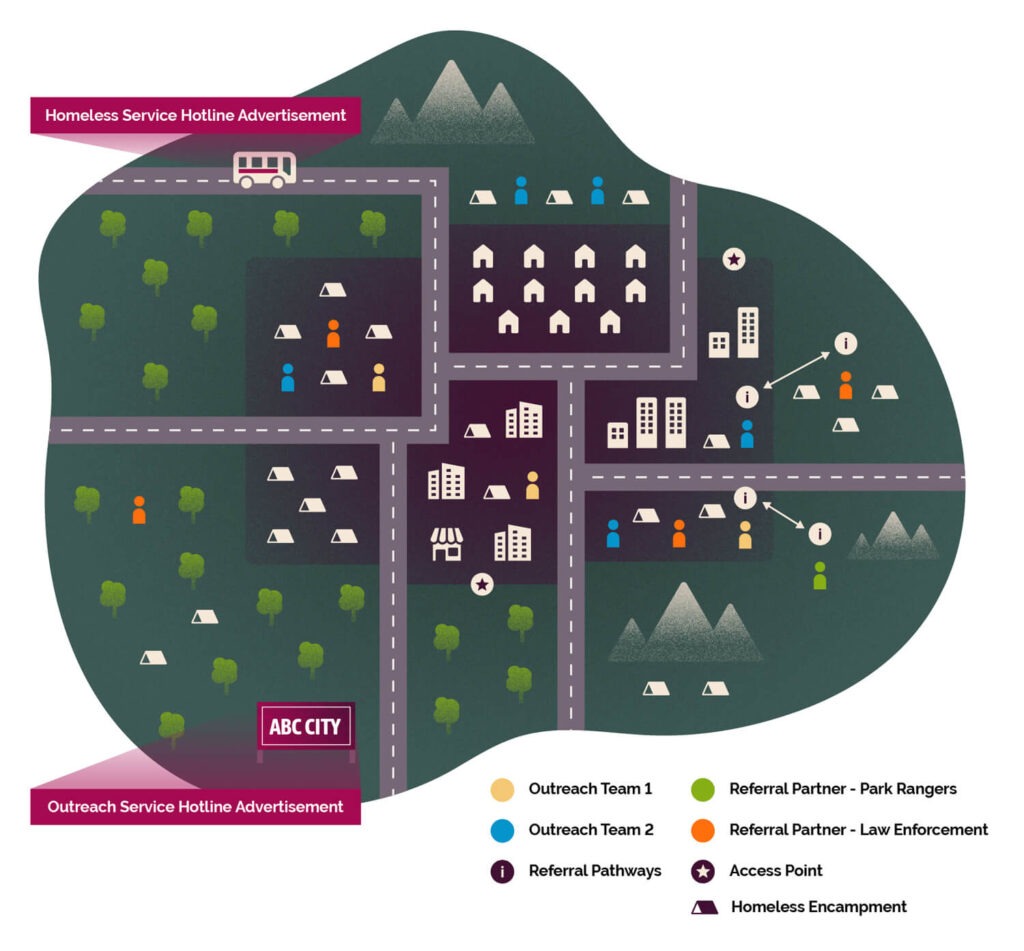
Accounting for providers that conduct outreach, but don’t collect or contribute data
Providers who conduct outreach but don’t directly contribute to the by-name dataset should have a clear process to ensure the people they serve are counted — such as referring to community access points, completing paper intake forms, or combining client rosters. This gives communities confidence that everyone experiencing unsheltered homelessness is connected to resources and reflected in the data.
Why does having coordinated outreach matter?
Ensures people are known and connected
Many people and households experiencing unsheltered homelessness cannot or choose not to access shelter, whether due to limited availability or high-barrier policies. Outreach services are essential to meeting people where they are and connecting them to their self-determined needs.
Improves effectiveness and efficiency
Coordinated outreach reduces duplication, prevents coverage gaps, and ensures people and households are connected to the right resource at the right time. An outreach collective, committee, or regular team meeting helps communities understand how teams are functioning across geographic areas and maintain a higher level of care coordination.
Establishes a shared approach
Written outreach policies and procedures create a shared understanding of how outreach is conducted locally, closing the gap between what outreach teams know and what the rest of the community expects. Documented practices also give teams a foundation for continuous improvement, including regularly reassessing schedules to meet evolving needs.
How to reach everyone experiencing unsheltered homelessness with minimal traditional outreach capacity
Build an outreach collaborative
Forming an outreach collaborative significantly reduces the burden on individual staff and enables more efficient use of limited resources while allowing teams to coordinate coverage, avoid duplication, and quickly identify clients served by multiple providers.
Develop referral pathways
Canvassing alone may not always reach every corner of a community. Accessible, well-promoted referral pathways allow the public and community partners to easily connect people and households to outreach services. Examples include:
- An online request for service form on the outreach agency’s website
- A dedicated hotline for service requests
- Coordination with adjacent systems (hospitals, schools, law enforcement, family resource centers)
Promoting pathways through resource navigation hotlines, flyers, social media, and local news and partnering with adjacent systems to ensure staff know how and when to make referrals can help bridge the gaps in coverage even if outreach teams have the capacity to thoroughly canvas.
Population Specific Guidance
The content above applies to outreach System-wide across all populations. The sections below highlight key nuances and considerations for specific populations your community may be focusing on.
Single Adults are the population most likely to experience unsheltered homelessness and to be served by traditional street outreach teams. Many outreach practices, like canvassing encampments and deploying mobile outreach teams are suited to support this population.
Key considerations for single adult outreach:
- Visible Homelessness: Single Adults are most likely to experience “visible” unsheltered homelessness and are more likely to reside in encampments, making geographic coverage mapping and encampment-focused outreach strategies especially relevant for this population.
- VA Collaboration: Veterans are a sub-population within the Single Adults population. Communities should coordinate closely with VA outreach staff to ensure veterans experiencing unsheltered homelessness are identified, engaged, and included in the by-name dataset. Establishing clear data-sharing agreements and referral pathways between VA and community outreach programs is essential.
Youth experiencing unsheltered homelessness require outreach strategies that reflect their unique circumstances, safety needs, and relationship to systems. Young people may be less visible than Single Adults and may have past experiences with systems (child welfare, juvenile justice) that shape their willingness to engage.
Key considerations for youth outreach:
Center Lived Experience and Peer Models: Involving Youth and Young Adults (YYA) with lived experience in designing and conducting outreach strategies ensures that the efforts are most relevant, accessible, youth-centered, trauma-informed, and trust-based. The most direct way to ensure that YYA with lived experience are involved is to hire YYA as outreach workers and peer navigators. Other methods include engaging youth on social media, with surveys, focus groups, and simply asking young people or your Youth Action Board to help map hot spots in your community.
Prioritize “In-reach” and Referral Pathways: For the YYA population, in-reach looks like deployment to and coordination with adjacent systems such schools, behavioral health and juvenile justice facilities, and the child welfare/foster care system. Successful in-reach requires both co-locating services in these familiar environments and connecting with host staff to execute warm handoffs to the homeless response system. Communities should have established and where applicable, formalized referral pathways with key adjacent systems to ensure consistent connection to services. More information on coordinating with adjacent systems can be found here [link to adjacent systems overview page]
Non-Traditional Outreach: Young people experiencing homelessness are often “hidden” and actively avoid adult shelter systems and highly visible adult encampments due to safety concerns. Outreach teams should adopt non-traditional outreach strategies that meet youth where they are, both physically and virtually. This can be achieved by engaging with local resource navigation hotlines, collaborating with emergency service departments, public transportation providers, churches, hospitals, law enforcement, grassroots BIPOC and LGBTQ+ groups, colleges, and libraries to ensure their staff are informed about the services available, and distributing flyers with clear instructions to request outreach.
💡Tips for Action💡
Consider a scannable QR code that links directly to a mobile-friendly text line – creating a vital bridge between physical and digital engagement. Additionally, social media campaigns and local news coverage can further enhance awareness and accessibility.
Coming Soon
Built for Zero is actively gathering best practices in family systems. Additional guidance will be added to this section as communities share their approaches.
Submit Questions or Feedback
We want to hear from you! Let us know if you have specific feedback, comments, or questions about the material on this page.
Submit Questions or Feedback
We want to hear from you! Let us know if you have specific feedback, comments, or questions about the material on this page.