Overview
The Quality Data Toolkit
Quality Data is the milestone communities reach when they have confidence that their by-name data is comprehensive and accurately reflects the realities of people navigating the homeless response system. This level of data quality allows communities to pinpoint where the system is falling short and target improvements to the parts of the system that need it most, thereby improving outcomes and measurably reducing homelessness. The Quality Data Scorecards are the mechanism communities use to assess how comprehensive and accurate their data is, at two tiers: Initial and Advanced. This toolkit outlines Built for Zero’s (BFZ) Quality Data standard and offers self-guided resources communities can use to achieve this milestone locally.
The new and improved version of the toolkit is focused on System-wide Quality Data. It begins with a comprehensive, System-wide view and provides population-specific guidance for Single Adults, Youth, and Families where applicable.
The toolkit is organized into nine sections that correspond to the applicable population scorecards. These sections represent key elements of local homeless response systems that BFZ has identified as essential for maintaining a comprehensive, accurate, reliable, and person-centered by-name dataset. For each section, the toolkit includes:
- the corresponding population scorecard questions
- an overview of the main themes, key definitions, rationale of why improving each area is essential, and examples of how each area can be put into practice
- tools and resources designed to support communities to address each of the scorecard questions in the section
- case study examples of how BFZ communities have addressed the core concepts of each section across their systems
Data Contribution
Policies and Procedures
Data Infrastructure
The theory behind Quality Data
BFZ’s methodology is based on the idea that building systems that can prevent, quickly detect, and effectively address homelessness requires five things:
- a shared aim
- an accountable community-wide team
- real-time data, which accounts for everyone by name and need (by-name data)
- centering of fair access
- targeted and data-driven housing investments
This toolkit focuses on helping communities create the systems necessary to have a by-name dataset that accounts for everyone experiencing homelessness by name and need.
How does BFZ define by-name data?
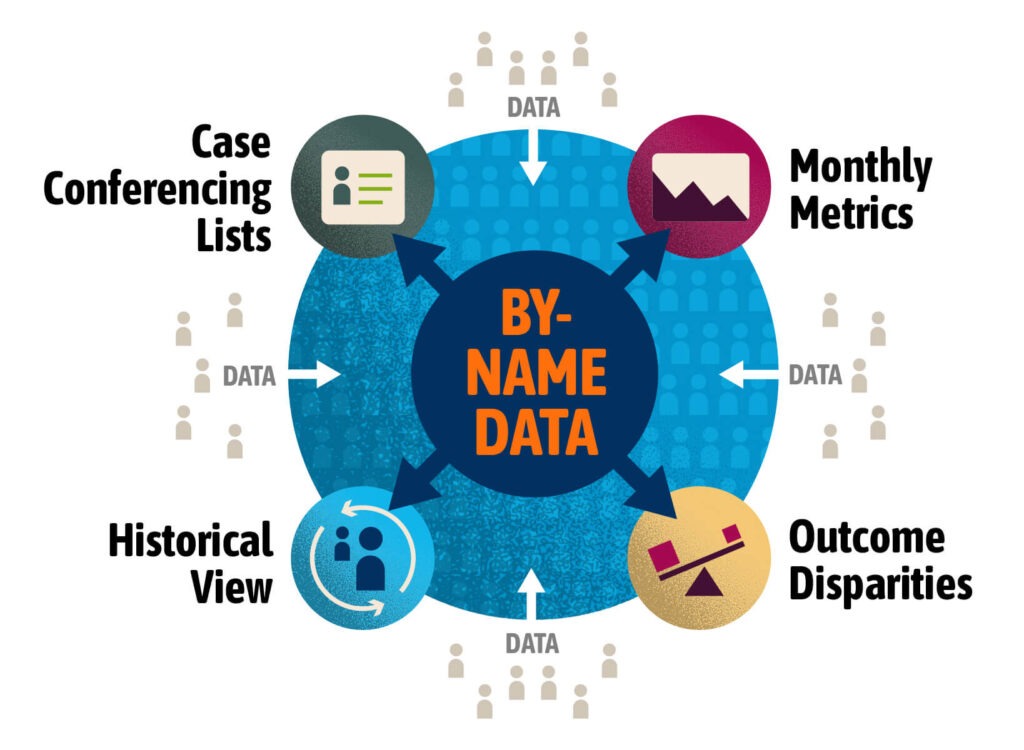
By-name data (sometimes referred to as a by-name list) is a comprehensive dataset of every person and household in a community experiencing homelessness, updated in real-time. Using information collected from across the homeless response system, each person or family in the dataset can be accounted for by name (or ID), household status, homeless history, and more. This data is updated monthly, at minimum, and can be used to develop a case conferencing list, report monthly BFZ metrics, build a historical view of the system, and analyze outcome disparities.
How to use this toolkit
The toolkit is designed to help communities evaluate their homeless response system as a whole, and can be used to address each question across the applicable population scorecards in support of the Quality Data milestone or to focus on specific areas for system improvement.
Each section begins with an overview page that provides foundational guidance applicable System-wide. In sections where population-specific considerations are essential for effective system design, nuanced guidance for Single Adults, Youth, and Family populations is included at the bottom of each overview page.
Users are encouraged to start with the overview pages to understand key definitions, the rationale behind each topic, and how concepts are applied in System-wide practice. The tools, resources, and case studies included throughout the toolkit are intended to support local implementation across the entire system, while remaining adaptable for specific target populations.
BFZ has established standards to guide communities working toward Quality Data and developed population-specific scorecard rubrics to serve as a measurement framework assessing the validity of metrics reported. Find out more about the standards on the Quality Data Standards page and rubrics on the Scorecard Rubrics page.