This year’s theme is Call to Action. Come ready to plan for broader action, with us, to reduce unsheltered homelessness in your community and nationally.
Location:
Sheraton Grand Seattle
1400 Sixth Ave
Seattle, WA 98101
Check out our detailed agenda or Frequently Asked Questions for more information. If you need more help, email us at bfzlearningsession@community.solutions.
AGENDA
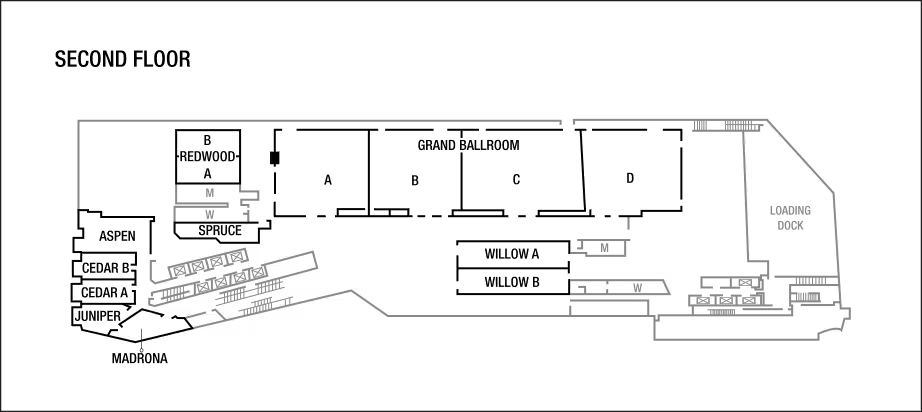
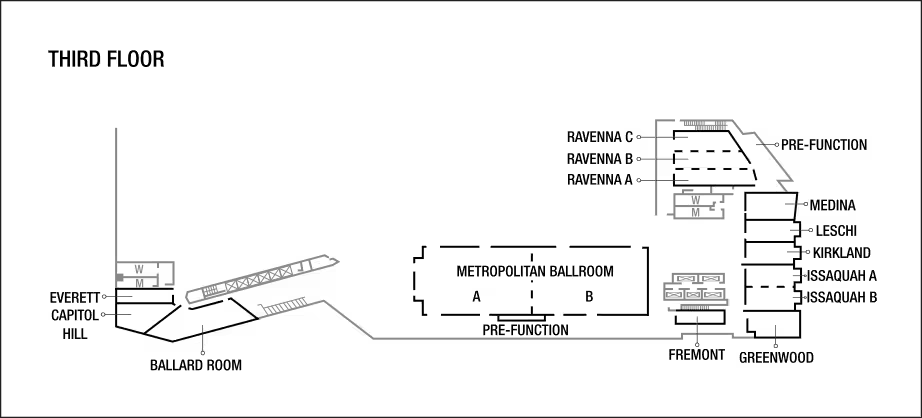
[ See the floor map ]
FREQUENTLY ASKED QUESTIONS
What is the address of the conference hotel?
All activities will be at the Sheraton Grand Seattle, 1400 6th Ave, Seattle, WA 98101. Book through our room block to get the best rate when you register!
Why should I stay at the conference hotel instead of somewhere else nearby?
We recommend staying at the conference hotel to ensure your team has an exceptional Learning Session experience!
Your team will have the best possible experience if you reserve a room on-site at the official conference hotel, the Sheraton Grand Seattle. Staying on-site will give your team more time to network, easily join sessions, and soak up knowledge from peers across the Built for Zero Network.
We have reserved a hotel block that locks in the lowest possible price at this hotel. The rooms in the hotel block are available on a first-come, first-served basis. Last year, they sold out very quickly, and Built for Zero is not able to support securing hotel accommodations once this block is full. Reserve your rooms in our exclusive room block now to secure a competitive rate and enjoy the perfect blend of comfort and convenience!
When should I plan on arriving and departing from Seattle?
Programming will begin with pre-conference sessions from 2:00-4:00pm PST on Monday, October 19. All sessions will be at the hotel or a readily accessible distance. These are being finalized based on interest and will likely include Mobile Workshops and Affinity Groups. We recommend teams arrive on Monday to ensure they can fully participate in programming on Tuesday. Learning Session programming will conclude after lunch on Thursday, October 22, and we encourage teams to book travel out of Seattle in the early afternoon.
How do I get to the Learning Session venue hotel from the local airports?
If you are flying into Seattle-Tacoma International Airport, you have three transit options to get to the hotel.
- Take Line 1 on the Link Light Rail from the airport station to the Westlake Station (38 mins), and the hotel is approximately a 5-minute walk from the station.
- Take a shared airport shuttle directly from the airport to the hotel (between 25-45 minutes).
- Take a taxi or a ride-share service like Uber or Lyft ( generally 20-30 minutes depending on traffic).
What if I need to cancel my registration or swap registration?
If you would like to cancel or modify the registrants for your community, please email bfzlearningsession@community.solutions.
How do I register for the Learning Session?
Registration for the Learning Session opens August 4th. Use this link to register.
Is the Learning Session a HUD-approved conference?
Yes! This is a HUD-approved learning session. Grantees can use their CoC, ESG, or YHDP project administrative dollars to attend.
Is there a maximum number of people from my community who can attend?
Each organization can register up to five people with the aim being that each community is represented by multiple partner groups. That keeps any single agency from filling the room while leaving space for as many partners from your community as want to join. We are doing outreach to cross-sector partners but if there is a group from your community you would like to see in attendance – local government, housing, health care, business, or philanthropy – you’re encouraged to invite them.
How do I decide who should attend from my community?
Who on your team and in your community is leading implementation on unsheltered? Who is tracking data and telling the story of results? Who is developing policy agendas and private-public partnerships for long-term success? We recommend bringing a multi-disciplinary team from your organization. And extending the invitation to groups you already work with but would like to coordinate with more actively. Check out the agenda to learn more about the programming to help identify the right representatives from your team and wider community.
Will travel stipends be offered?
Unfortunately, we are unable to offer communities travel stipends this year. As always, the conference is completely free, and all meals listed on the conference agenda will be provided to participants.
I have more questions.
Email bfzlearningsession@community.solutions with any additional questions.
Dinner Options in Seattle
Closed days at a glance
(everything else is open 7 days a week)
- Sunday: The Pink Door
- Monday: The Pink Door, Maneki, Vital Creations
- Tuesday: Kau Kau BBQ, Vital Creations
- Wednesday: Vital Creations
- Thursday to Saturday: everything open
The 10-Minute Walk
These options are on the way to Tuesday’s special event at Pier 70
Serious Pie Downtown: Buzzy, communal pizza spot that’s great for groups; get the clam pizza. About 8 min walk from the hotel, then 16 min to Pier 70. Pizzas about $22–28; open daily.
Lola: Cozy Tom Douglas Greek spot with shareable kebabs and spreads; book ahead, kitchen closes at 9 PM. About 8 min walk from the hotel, then 16 min to Pier 70. Entrées about $28–40; open daily.
The Pink Door: Romantic, lively Italian in Pike Place Market; the lasagna is the move. About 10 min walk from the hotel, then 16 min to Pier 70. Entrées about $25–38; closed Sunday and Monday.
Umi Sake House: Stylish, packed sushi bar with a great 4 PM happy hour and vegetarian rolls. About 14 min walk from the hotel, then 10 min to Pier 70. Rolls and plates about $15–25; open daily.
Rocco’s: Loud, retro pizza-and-cocktails bar with huge slices, open until midnight. About 14 min walk from the hotel, then 10 min to Pier 70. Slices about $6–8; open daily.
Some Random Bar: Calm Belltown gastropub; try the garlic pull-apart bread and chowder. About 18 min walk from the hotel, then 6 min to Pier 70. Entrées about $16–24; open daily.
LateNight Cravings (open past 11 PM)
Dick’s Drive-In, Queen Anne: No-frills Seattle burger institution with indoor seating, open until 2 AM. Quick rideshare from the hotel (1.6 mi), then 15 min walk from Pier 70. Burgers about $5–7; open daily.
Dick’s Drive-In, Capitol Hill: Walk-up windows only and a late-night rite of passage, open until 2 AM. Quick rideshare from the hotel (1.2 mi) or from Pier 70 (2 mi). Burgers about $5–7; open daily.
Big Mario’s Pizza: Grungy, friendly dive with New York slices (vegan ones too), open until 2 AM. Quick rideshare from the hotel (1 mi) or from Pier 70 (2 mi). Slices about $5–7; open daily.
Ba Bar: Stylish Vietnamese café-bar, open until midnight; get the Saigon wings. Quick rideshare from the hotel (1.2 mi) or from Pier 70 (2.3 mi). Entrées about $18–28; open daily.
13 Coins, Pioneer Square: Old-school booths and big portions, open until 1 AM on Fri and Sat only (11 PM other nights). Quick rideshare from the hotel (1.1 mi) or from Pier 70 (2 mi). Entrées about $22–40; open daily.
Local Flavor Icons
Taylor Shellfish Oyster Bar: Small farm-run oyster bar on Capitol Hill; try geoduck, reserve ahead, closes at 8 PM (9 PM Fri and Sat). About 12 min walk uphill from the hotel, then a rideshare to Pier 70 (1.5 mi). Entrées about $20–30; open daily.
Paseo: Tiny, beloved Caribbean sandwich counter in Fremont; get the Caribbean Roast. Rideshare from the hotel (4 mi) or from Pier 70 (3.5 mi). Sandwiches about $15–18; open daily, closes 6 PM Sun and Mon.
Maneki: Homey, historic Japanese spot in the International District; reserve for the 5 PM opening. Quick rideshare from the hotel (1.2 mi) or from Pier 70 (2 mi). Entrées about $20–35; closed Monday.
Kau Kau BBQ: Fast, cheap Cantonese BBQ counter in Chinatown-ID; go early, it closes at 7:30 PM. Quick rideshare from the hotel (1.3 mi) or from Pier 70 (2.2 mi). Plates about $12–18; closed Tuesday.
Dietary-Friendly Gems
Next Level Veggie Grill: All-vegan counter service with gluten-free items labeled; quick and easy. About 4 min walk from the hotel, then 22 min to Pier 70. Entrées about $14–18; open daily.
Plantiful SLU: Bright all-vegan café with burgers, bowls and smoothies; closes at 8 PM. About 18 min walk from the hotel, then a rideshare to Pier 70 (1.1 mi). Entrées about $15–20; open daily.
Cafe Flora: Seattle’s vegetarian and vegan landmark, a garden-like room with a full bar. Rideshare from the hotel (2.5 mi) or from Pier 70 (3.5 mi). Entrées about $20–28; open daily.
Araya’s Place: Cozy all-vegan Thai in the University District; get the tofu satay. Rideshare from the hotel (4.5 mi) or from Pier 70 (5 mi). Entrées about $16–20; open daily, closed 3 to 4:30 PM.
Vital Creations Vegan Bistro: Laid-back, beachy all-vegan comfort food in Fremont. Rideshare from the hotel (3.5 mi) or from Pier 70 (3.2 mi). Entrées about $16–22; closed Monday through Wednesday.